Who Owns the Payment Rails · Part 3
Half-Right, Again: Stripe Just Bid $53 Billion for PayPal
On 14 July I published Part 1 of this series with a confession: I'd spent eighteen months convinced Stripe was building a walled garden to own payments outright, and Open USD proved me half-wrong. Nobody could own the rail. Distribution beat ownership. The garden was never Stripe's to wall off. I filed it, felt reasonably good about the intellectual honesty, and moved on to the banks.
One day later — 15 July — Reuters reported that a Stripe-led consortium had bid roughly $53 billion for PayPal.
My first reaction was the obvious one: there goes the thesis. My second reaction, which is what this post is about, is that the bid doesn't contradict Part 1 nearly as much as the headline suggests — read the fine print and it might be the strongest evidence yet that Part 1 was right. But I don't get to just assert that. A thesis that can't survive being stress-tested in public within twenty-four hours of publication isn't a thesis, it's a horoscope. So let's stress-test it.
What happened — and, just as important, what hasn't
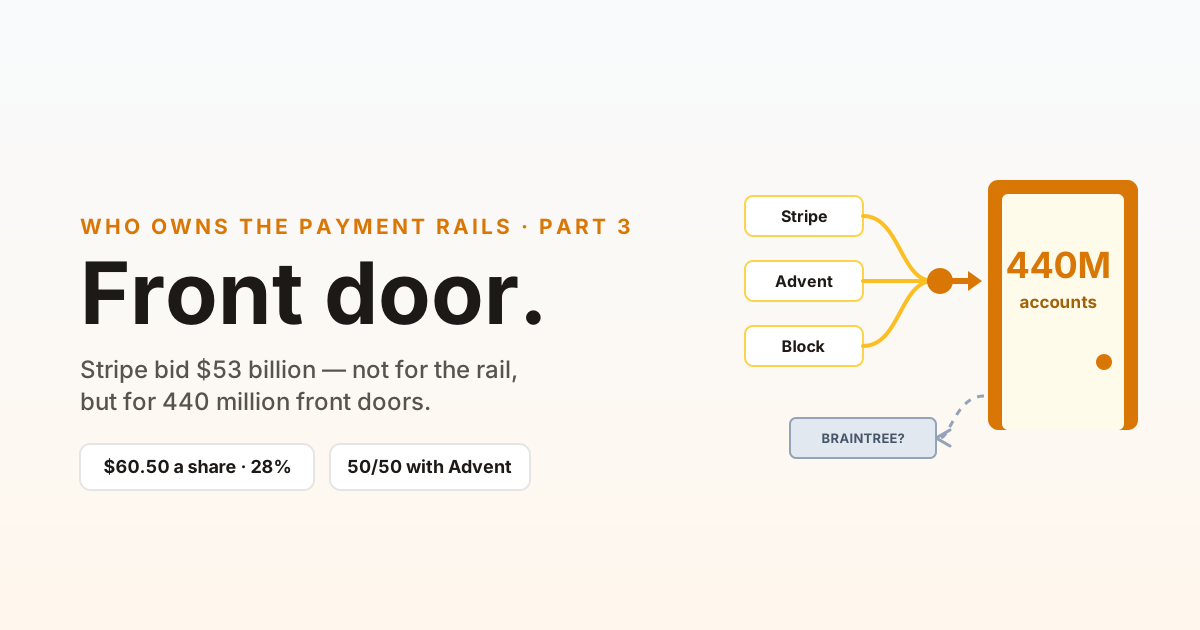
On 15 July 2026, Reuters reported that Stripe and the private-equity firm Advent International had submitted an unsolicited takeover offer for PayPal: $60.50 a share, valuing the company at roughly $53 billion ($53.4 billion on the day's numbers) — a 28% premium to the prior close of $47.37. CNBC's David Faber and Bloomberg independently confirmed the approach, and PayPal's stock surged 16–19% on the day.
Now the caveats, because this series lives in the fine print. This is an unsolicited bid, under review, from a consortium. It is not "Stripe's acquisition of PayPal", however many headlines say otherwise. No company involved has confirmed anything on the record. There is no SEC filing. Every detail below traces back to anonymous-sourced reporting, and I'll flag the single-source claims as we hit them. The bid is real enough to move a $40-billion-plus market cap by double digits in a day; almost nothing beyond that is settled.
The surface read: the garden, rebuilt
Take the reporting at face value and Part 1 looks demolished. Consider what would sit under one roof if this closed:
- PYUSD — PayPal's stablecoin, issued by Paxos. A house coin with real distribution.
- Bridge — stablecoin issuance and orchestration, Stripe's ~$1.1 billion buy.
- Privy — embedded crypto wallets.
- Tempo — the payments-first Layer-1 Stripe co-incubated.
- Open USD membership — a seat at the shared-coin table for both companies.
- And the crown: ~440 million active PayPal accounts, plus Venmo.
The volume maths is silly. PayPal moved $1.79 trillion in payment volume in 2025; Stripe processed $1.9 trillion. Combined, that's roughly $3.7 trillion a year — analyst estimates put it near 65% of global online payment volume.
That is, line for line, the empire I described in Part 1 — with the one asset I said Stripe couldn't clone quickly, consumer distribution, bolted on for $53 billion. If the deal happened the way the headlines frame it, the honest move would be to retitle Part 1 "I Was Right the First Time" and eat the correction whole.
But that's not the deal on the table. Look at how the bid is built.
The fine print: the structure concedes the thesis
Per the reporting — anonymous-sourced throughout, so hold it loosely:
- Stripe isn't bidding alone. Stripe and Advent would own PayPal jointly, at equal 50/50 stakes. Half the walled garden would belong to a private-equity firm.
- The money isn't Stripe's alone either. Roughly $17 billion of equity contributed by Stripe, Advent and Block, sitting on top of about $50 billion in committed bank financing.
- The stated plan is to keep PayPal intact — not to fold it into Stripe.
- And the tell that matters most: the consortium reportedly pre-planned its antitrust remedies, considering carving out PayPal's Braintree merchant-processing business to Advent. That detail rests on a single anonymous source in one Reuters exclusive — "considered", not decided — so weight it accordingly. But even as a consideration, note what it is: the bidders sketching a divestiture of the processing business before a regulator has asked a single question.
You don't structure a bid like that to own a rail. The walled-garden Stripe of my Part 1 imagination would have bought this stack outright and welded it shut. The actual Stripe of 15 July split ownership down the middle with a PE firm, took Block's money — a competitor's money — borrowed $50 billion from the banks, promised to leave the target standing, and pencilled in giving away the merchant-processing arm before anyone made it. That is not a company that believes it can own the vertical. That is a company that read the same Open USD launch I did, reached the same conclusion — the rail is shared now — and repriced what's actually still worth buying.
What $53 billion buys when the rail is shared
Which brings us to the real question: if not the rail, what?
Distribution. The front door. Part 1 ended with the lesson that in payments, distribution beats ownership — and Stripe's entire empire, formidable as it is, lives on the merchant side. Stripe is the infrastructure behind the buy button; it has never owned the consumer who presses it. PayPal owns roughly 440 million of them, plus Venmo, plus two decades of "just log in with PayPal" muscle memory.
And once the settlement layer is a shared standard — Open USD as the coin, open protocols like x402 pushing the same logic up into the payment layer itself — infrastructure stops being the moat. Everybody clears over the same shared rail; the coin's yield flows back to a 140-company consortium; the protocol is anyone's to implement. What's left scarce is the relationship with the human at the front. Movement Labs' CEO put it cleanly to CoinDesk: "The name on the front of the wallet means far less than whose infrastructure clears the payment behind it." He meant it as a warning about PayPal's position. I'd run it in reverse: when everyone's infrastructure clears the same shared coin, the name on the front of the wallet is precisely what's left to buy. Stripe already has the back. Reportedly, it just bid $53 billion for the front.
William Blair, notably, argued that "the industrial logic for the acquisition is difficult to establish." I'd agree — if you think this is an infrastructure deal. Two processing stacks, overlapping stablecoin plays, a redundant chain: hard to justify. As a distribution deal it's the only logic there is.
The board's answer, so far: not enough
PayPal isn't rolling over. Per a Reuters exclusive on 16 July, the board considers $60.50 inadequate — it "does not fully reflect the potential value" — and is weighing financing certainty, regulatory risk and timeline. It has retained Goldman Sachs and Evercore, and reportedly meets as soon as 20 July 2026. A detail I find delicious: an earlier approach in April 2026 apparently went unanswered.
The analyst split is wide open. BTIG called the bid "a lifeline worth taking". William Blair called it a possible "low-ball offer" and said the bidders "could go as high as $70 a share if pressed" — while flagging that as low-probability. Michael Burry declared it "simply too low", putting fair value at $75–$115. Polymarket has it around 80% that an acquisition eventually happens, at some price, to some buyer.
Three ways this breaks — and what each does to the thesis
The board meets as soon as 20 July. Three branches from here — and everything in this section was written before that meeting, so read it as a prediction, then see the update below for how it landed:
- Reject outright. The cleanest outcome for my thesis and the messiest for the market — PYPL is trading well above the pre-bid price on deal hope alone. But note the bid already did its evidentiary work: Stripe tested whether the front door could be bought, and "not at this price" wouldn't change what it was shopping for.
- Negotiate up — toward William Blair's $70 scenario, or Burry's range beyond it. Here's the part I find clarifying: every extra dollar would be a dollar paid for distribution, because the consortium has reportedly already contemplated handing the processing business to Advent. The higher the price climbs, the more nakedly this becomes a bid for 440 million front doors — and the stronger the Part 1 lesson gets.
- Accept at or near $60.50. The maximal outcome — and even then, look at what Stripe would hold: half of a wallet company, alongside a PE firm, financed by $50 billion of bank debt, with the merchant-processing arm possibly earmarked for someone else. A co-owned front door on a shared rail. Not a toll booth. Not a walled garden.
That's why I'm calling this one half-right, again — in advance, this time. If I was wrong in Part 1, I was wrong about Stripe's appetite, not its constraints: I said the walled-garden ambition was dead, and $53 billion says the ambition is very much alive. But the shape of the bid says the constraints won — Stripe now pursues empire the only way the shared rail allows, in a consortium, with partners, pre-conceding the pieces regulators would take anyway. The garden's back on the shopping list. The walls aren't.
In Part 1 it took an announcement to show me which half of my call was wrong. This time the test was scheduled — and it arrived four days later.
Update — 20 July 2026: the board says no, and means "not yet"
On 20 July, at a specially convened meeting, PayPal's board formally rejected the $60.50 offer. Same caveat as everything above: sourced to people close to the situation, no SEC filing, nothing on the record from any party. But it's the formal turn rather than a re-run of the earlier signal — as late as 19 July, PYMNTS and others were reporting the board had privately concluded the bid undervalued the company while pointedly noting it had not formally responded.
So: branch two. Not the clean rejection of branch one — the board is reported to be steering toward roughly $70 a share, and analysts read the refusal as an opening position rather than a closed door. Which is the outcome I said would sharpen the thesis rather than dent it, so let me be specific about why, and then about what I got wrong.
Three grounds reportedly drove the refusal, and two of them are the fine print doing its usual work:
- Price. $60.50 is a 28% premium on a company that carried a $360 billion market capitalisation five years ago. Whether that reads as generous or insulting depends entirely on whether you believe the turnaround.
- Financing. J.P. Morgan and Morgan Stanley assembled the ~$50 billion package and advise the consortium. PayPal's own advisers — Goldman Sachs and Evercore — are unlikely to treat that dual-hat arrangement as procedural.
- Regulatory risk, which I'd argue is the most durable of the three. A combined entity clearing ~$3.7 trillion a year draws an antitrust review that typically runs 18 to 24 months and can demand divestitures — each of which risks hollowing out the deal's own logic.
Read that last point against the Braintree carve-out the consortium had reportedly already contemplated. The bidders aren't discovering the regulatory constraint at the board's hands; they priced it in before submitting. That is still not the behaviour of a company that thinks it can own a vertical.
And the competitive picture shifted while all this was happening. Four days before the meeting — 16 July — Visa launched its Stablecoin Platform in beta, giving banks, fintechs and crypto-native firms one environment to mint, redeem, hold and transfer stablecoins across Visa's institutional client base and 200 million merchants. The institutional layer of programmable money is being claimed. The consumer layer is the one still unspoken for, and PayPal holds it. That's the split I'll take apart in Part 4 — and it's the cleanest explanation yet for why Stripe moved in July rather than waiting for the standards to settle.
The board's leverage, meanwhile, is the sheer width of Wall Street's disagreement: targets run from $50 (Mizuho, Macquarie, both neutral) through Cantor Fitzgerald's $54 — whose own sum-of-the-parts work implies about $70 — to Clear Street at $61, with Michael Burry at $75–80 conservative and $110–115 base case, arguing a winning bid needs to approach $100. That spread isn't a disagreement about PayPal's future. It's a disagreement about which PayPal you're buying: the processor, or the front door.
Where I'd mark myself: I called the branch correctly and I'd argue the reasoning held — the rejection is about price, and every dollar of that price is a dollar for distribution, because the processing business is already pencilled out. What I underrated was the timeline. I framed 20 July as the test. It wasn't; it was the first round. The real one is 28 July, when PayPal reports Q2 earnings and management has to show the numbers that justify turning down $60.50 in cash. If the quarter disappoints, the board's $70 becomes considerably harder to hold.
The thesis stands, then, but on a longer clock than I gave it. I'll keep updating this as it moves. If you're keeping score — or betting against it — I'm easy to reach.
← Earlier in this series: Part 1 — I Thought Stripe Would Own Payments. I Was Half-Right. · Part 2 — SWIFT 'Went Crypto', But Not How You Thought · and the piece that started it, Open USD: The Settlement Layer Just Picked a Side
Sources
- CNBC — Stripe, Advent offer to buy PayPal for more than $53 billion, Reuters reports (15 Jul 2026)
- CoinDesk — Stripe's $53 billion PayPal bid is a high-stakes play to own the future of digital payments (16 Jul 2026)
- Reuters via Yahoo Finance — Exclusive: PayPal board sees Stripe consortium's $60.50 offer as inadequate (16 Jul 2026)
- PYMNTS — PayPal board calls $53 billion Stripe-Advent bid inadequate (17 Jul 2026)
- CoinCentral — Why the board says Stripe's $60.50 bid isn't enough (19 Jul 2026)
- Tech Times — PayPal board rejects $53B Stripe-Advent offer: stablecoin race explains why the next move matters (20 Jul 2026)
Written in the days after the 15 July 2026 bid reports, before PayPal's board had responded, and updated on 21 July 2026 following the board's formal rejection — Part 3 of a short series on who ends up owning the payment rails. I work on the delivery side of frontier tech; these are my own views, not my employer's.
Written by Luke Shulver — Operations Manager at Labrys.
Get in touch→