Agentic Payments · Part 3 of 3
Open USD: The Settlement Layer Just Picked a Side
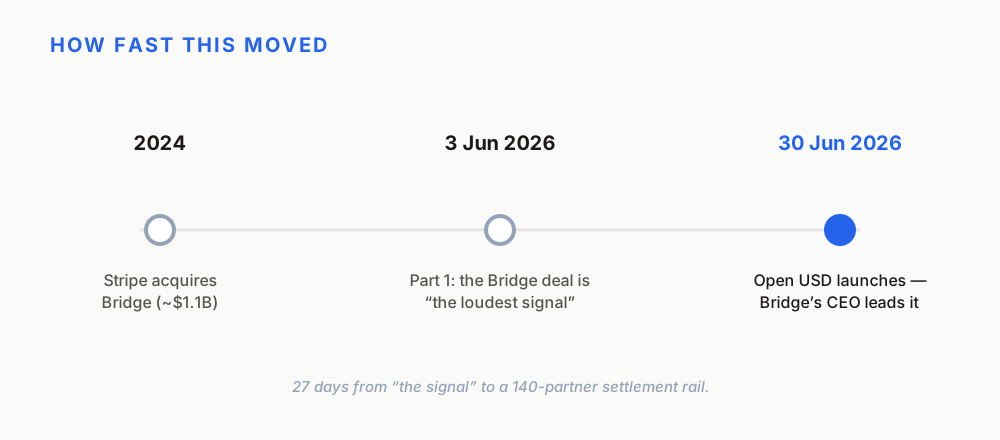
In Part 1 of this series, written on 3 June, I made a fairly confident claim: that underneath the noise, the settlement story for agentic payments had already converged on stablecoins — and that Stripe's roughly USD 1.1 billion acquisition of Bridge was the loudest signal that the major payments players agree.
I did not expect to be proven right quite this fast. On 30 June, Open Standard announced Open USD (OUSD) — a shared, industry-wide stablecoin backed by more than 140 companies — and its founding CEO is Zach Abrams, the co-founder and CEO of Bridge, the very firm Stripe bought. The signal didn't just point at the settlement layer. It walked up and planted a flag in it.
This is the follow-up I promised. It's worth working through what actually launched, why the economics are the real story, and what it changes for anyone building on the two earlier pieces.
What actually launched
Open USD is a dollar-pegged stablecoin operated not by a single issuer but by Open Standard, an independent company whose board is made up of its partner businesses. The partner list, reported at 140-plus companies, reads like a merger of the payments, banking, and crypto establishments:
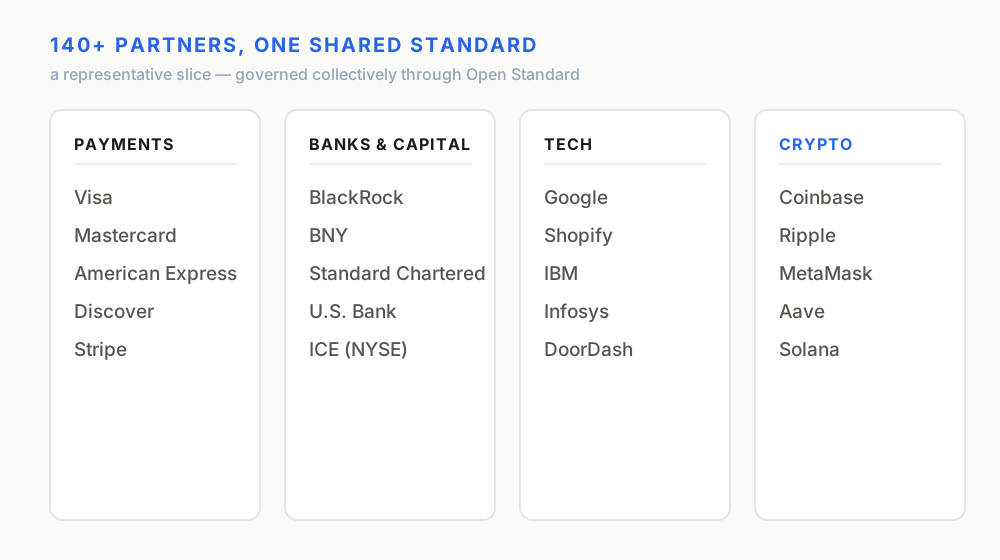
A representative slice of the consortium — the full list runs past 140 names.
Payment networks (Visa, Mastercard, American Express, Discover), Stripe, asset managers and banks (BlackRock, BNY, Standard Chartered, U.S. Bank, and Intercontinental Exchange, which owns the NYSE), tech platforms (Google, Shopify, IBM, Infosys, DoorDash), and crypto-native players (Coinbase, Ripple, MetaMask, Aave, Solana). Notably absent: Meta, whose Libra/Diem was the last serious attempt at exactly this and died under regulatory pressure in 2019.
The token is set to go live later in 2026. Reporting has it launching across multiple chains — Solana first, with Base, Stellar, Polygon and Stripe's own Tempo chain following — with Stripe making OUSD the default stablecoin for businesses on its platform and Coinbase bringing it to Base. Founding CEO Zach Abrams framed the pitch directly: "Existing stablecoins have great strengths, but to use them at scale, businesses need something that's open, low-cost, high-throughput, broadly accessible, and aligned to their interests."
The economics are the real story
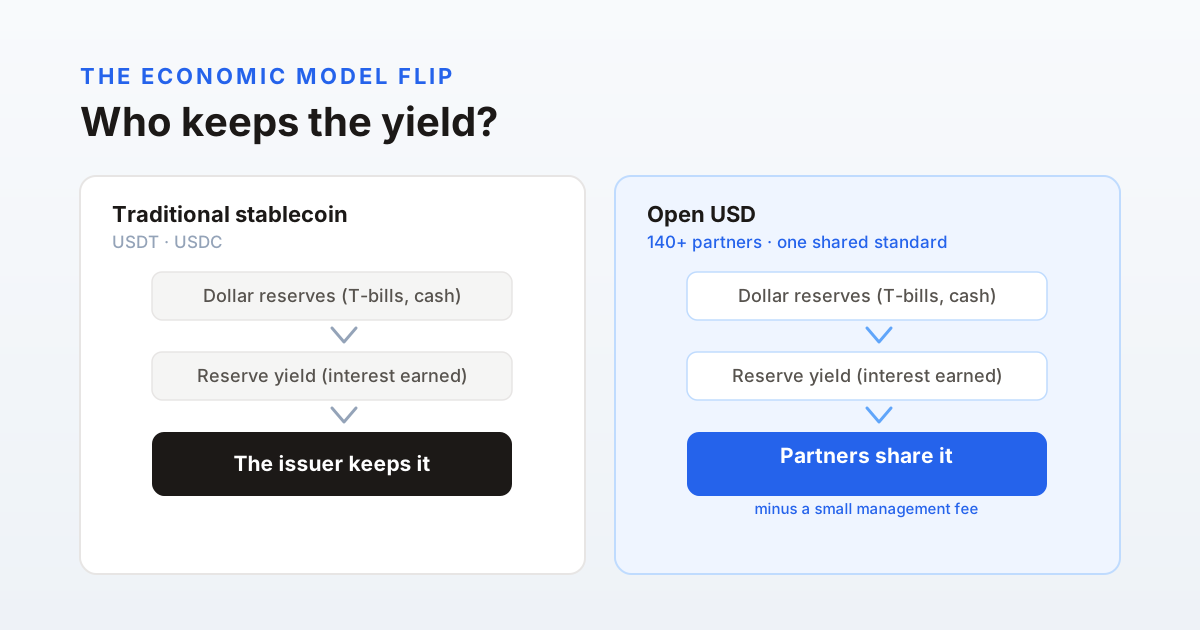
The headlines led with the logos, but the interesting part is the business model. Open USD is built on three design principles: mint and redeem at no cost with no volume caps; partners receive nearly all of the reserve earnings, minus a small management fee; and the whole thing is governed collectively rather than by one company.
That second point is the one that matters, and it's worth being precise about why. A stablecoin is, financially, a money-market fund with a payments API bolted on. You hand the issuer dollars, they hold T-bills, and the interest on those reserves is the prize. Under the incumbent model, the issuer keeps that yield — it's how Tether and Circle make most of their money. Open USD flips the direction of that cash flow: the partners who actually drive adoption get the reserve revenue back.
That's not a rounding-error difference. It rewrites the incentive that has governed stablecoin distribution since day one. Every one of those 140 partners now has a direct financial reason to prefer OUSD over USDC or USDT in their own products — because with OUSD, volume they route earns them a slice of the reserve yield instead of handing it to a competitor. Distribution stops being a favour you do the issuer and becomes a revenue line. That is a genuinely different game.
The market read it that way immediately. Circle — the publicly traded issuer of USDC — saw its stock fall in the mid-teens percent on the news. For context, as of April 2026 Tether's USDT held roughly 62% of the stablecoin market and Circle's USDC around 25%, per CoinGecko. A consortium isn't guaranteed to dislodge them — but the reserve-sharing model is the first structural attack on the incumbents' core economics rather than just another me-too coin.
The part I'd temper
I try to give the bullish read a counterweight, and this one deserves a firm one.
Consortiums are where ambitious payments projects go to move slowly. A 140-partner board is a governance achievement and a governance liability in the same breath. Libra had a comparable roster and never shipped; the thing that killed it was regulatory, but the thing that would have slowed it regardless was decision-making by committee. "Governed collectively" is a real virtue for neutrality and a real tax on speed. The GENIUS Act has since made the US regulatory picture far friendlier than it was for Libra in 2019 — which is a big part of why this is possible at all — but execution risk has simply moved from "will regulators allow it" to "can 140 companies actually agree on a roadmap."
And the incumbents aren't inert. USDT and USDC have years of liquidity, integrations, and trust that a launch announcement doesn't erase. "Later this year" is doing a lot of work in every article about OUSD, this one included. Until there's real on-chain volume, this is a very heavyweight intention, not a settled outcome.
Why this matters for agentic payments specifically
Here's the through-line back to the rest of the series. In Part 1, I sketched the agentic-payments stack as three layers — protocol, network, and settlement — and said the settlement layer had quietly converged on stablecoins while the protocol layer was still a fight. Open USD is the settlement layer acquiring the one thing it was missing: a default, and distribution to match it.
For a team building agent-initiated payments, a widely-backed, agent-friendly settlement token — fee-free to mint and redeem, no volume caps, natively multichain — is exactly the primitive that was missing. If OUSD delivers, "which stablecoin does my agent settle in" gets a boring, obvious default answer, and boring defaults are how infrastructure actually gets adopted.
But — and this is the whole reason Part 2 exists — a better settlement rail does not fix a single one of the failure modes I wrote about. A prompt-injected agent will drain an OUSD wallet exactly as happily as it drained the Grok/Bankr one. Decimal confusion doesn't care whose logo is on the coin. If anything, a frictionless, default, agent-native rail with real distribution raises the stakes, because it removes the friction that was quietly protecting sloppy implementations. Scoped authority, two-stage execution, adversarial evals, a tested kill switch — all of it matters more the moment settling money becomes this easy, not less.
So my advice from Part 1 stands, just with more urgency behind it: run the scoped experiment now, pick your rail (the default just got a lot more obvious), and build the guardrails from Part 2 as if the money is real — because it's about to be trivially easy to move.
I called the settlement layer four weeks ago. I'll happily admit I didn't expect it to name itself this quickly. If you're building in this space and want to compare notes on where it goes next, I'm easy to reach.
← Earlier in this series: Part 1 — Build Now, or Wait? · Part 2 — How to Build Them Without Breaking Them
Sources
- Open Standard — Introducing Open USD (official announcement)
- The Block — Visa, Stripe, Coinbase and more join Open USD stablecoin that shares reserve revenue
- Fortune — Stripe, Visa and over 140 other businesses to launch stablecoin to rival Tether and Circle
- Ledger Insights — Visa, Mastercard, BlackRock, BNY back new OpenUSD stablecoin with 140 partners
- CoinDesk — Jefferies warns against buying the dip in Circle as Open USD raises new competition fears
- CryptoPotato — What is OpenUSD (OUSD)?
Written 4 July 2026, in the days after the announcement — the follow-up I flagged in Parts 1 and 2. I work on the delivery side of frontier tech; these are my own views, not my employer's.
Written by Luke Shulver — Senior Project Manager at Galaxy.
Get in touch→