Who Owns the Payment Rails · Part 2
SWIFT 'Went Crypto', But Not How You Thought
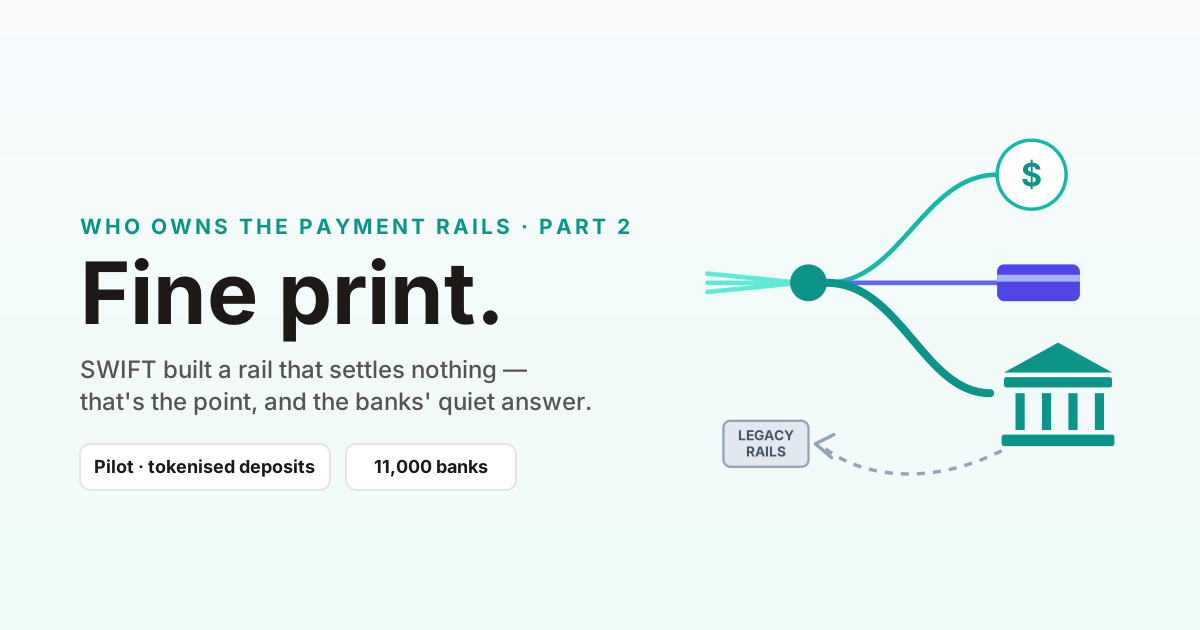
If you only read the headlines this week, SWIFT — the messaging network that around 11,000 banks use to move money across borders — just went crypto. "SWIFT goes live on the blockchain." "XRP's moment has arrived." "Banks finally embrace on-chain settlement."
Read the fine print and it's a smaller, quieter, and frankly smarter story than any of that. Which is exactly why it's the most interesting move in payments this month — and the next chapter in the question I've been chasing since Part 1: who actually owns the rail.
What SWIFT actually shipped
On 9 July, SWIFT announced its blockchain-based shared ledger was "ready for initial use," with 17 banks across six continents — Citi, HSBC, UBS, BNY, Standard Chartered, Wells Fargo, DBS and MUFG among them — lined up to pilot it. It was built in about nine months on Hyperledger Besu, a permissioned, Ethereum-compatible chain, with Consensys delivering the prototype.
Now the four details most of the coverage skated past:
- It's a pilot, not production. The banks are preparing to test it; at the announcement, the first live transactions hadn't happened yet. "Ready for initial use" is doing a lot of work in every headline.
- It moves tokenised bank deposits — not stablecoins, and not CBDCs. Bank money, tokenised, sitting on the banks' own ledgers.
- It's not "on Linea," and it doesn't touch XRP. It's a permissioned enterprise network, not a public chain, and it deliberately avoids public-network assets. A former SWIFT executive flatly denied any XRP integration — the "Ripple moment" framing was wishful.
- And the big one — it settles nothing on-chain. The ledger records, sequences and validates the banks' payment commitments to one another through smart contracts. Final settlement still happens through the existing rails — RTGS, correspondent banking. In SWIFT's own words, it's "a secure orchestration layer… before completing final settlement through existing systems."
So the accurate one-liner: SWIFT built a blockchain that settles nothing — yet. And I don't mean that as a dig.
Why "settles nothing" is the clever part
Strip away the disappointment of the crypto crowd and look at it as a strategy move. The incumbent has found a way to absorb the genuinely useful parts of blockchain — 24/7 operation, programmable timing, a shared source of truth for who-owes-whom across a payment chain — without ceding the two things that actually matter: money issuance and final settlement. Those stay with the banks and the existing rails, which is to say, they stay inside SWIFT's world.
Now line the three answers up side by side. The stablecoin answer — Open USD — tells a bank: adopt a new dollar token issued by a consortium. The card-network answer, which I dug into in Part 1, says: route it through Visa and Mastercard. SWIFT's answer to its 11,000 banks is the most conservative and, for a bank, the most appealing of the three: you don't need anyone else's coin. Tokenise your own deposits, keep them on your own ledger, and we'll coordinate the timing on a chain you collectively control.
Put yourself in a bank's treasury or compliance seat, choosing between "a stablecoin issued by a consortium" and "our own regulated deposit, tokenised, still fully under our control." That's not a hard call. SWIFT just handed banks a way to get the out-of-hours, programmable benefits of on-chain money without any of the parts that make a risk committee sweat.
Three camps, not one winner
Here's where it plugs back into the series. Earlier this month the settlement-layer story looked like it was converging on stablecoins. It isn't converging — it's fragmenting into three camps, each with a different owner:
- The stablecoin consortium — Open USD, with Visa, Mastercard, Stripe, Coinbase and BlackRock behind one shared coin.
- The card networks — jockeying to be the toll road everything routes through (Part 1).
- The interbank system — SWIFT and the banks, with tokenised deposits on a ledger they own.
None of them is winning outright, and they aren't even really the same product. A consortium stablecoin, a network toll road, and a bank-deposit coordination layer are three different answers to the same question: what is money on the internet, and who keeps the ledger? The honest update to the call I made a couple of weeks ago — that the settlement layer had "picked a side" — is that it hasn't picked one side. It's split into three.
The part I'd temper
This one cuts both ways, so let me give it a firm counterweight in both directions.
Against the hype: it's a pilot with no live transactions, final settlement still runs on the sixty-year-old plumbing, and "old bottlenecks persist" is a fair critique — a shiny coordination layer bolted onto legacy settlement is still gated by legacy settlement. A committee of 17 banks agreeing on a roadmap is the same governance-by-committee tax I flagged when Open USD launched with 140 partners; ambitious payments projects backed by big rosters are where speed goes to die.
But also against the reflexive cynicism: the tech press got this wrong in the loud direction — "Linea!", "XRP moment!", "SWIFT goes crypto!" — and the right response isn't to swap that out for SWIFT hype. It's to read what actually shipped. What shipped is modest and unfinished. It's also the most strategically sound move on the board, precisely because it costs the banks nothing to control and gives crypto-native settlement players nothing to disintermediate.
What it means if you're building
If you're building payments — agentic or otherwise — the practical takeaway is that "which rail is the default" just got harder, not easier. Two weeks ago the answer was trending toward "a stablecoin." Now a builder faces three institutional answers, none dominant, and the bank-money one has the deepest pockets and the least incentive to move quickly. Pick your rail knowing the field is contested, and will stay contested for a while yet.
And the guardrails point I keep coming back to still stands, whoever wins: a better, faster, always-on rail doesn't fix a single one of the failure modes. A mis-scoped agent drains a tokenised-deposit wallet exactly as happily as it drains a stablecoin one. Whatever the rail, build like the money is real — because on every one of these three, it's about to be.
I called the settlement layer a fortnight ago and said it had picked a side. SWIFT's move is the clearest sign yet that it hasn't — it's picking three. If you're building on any of these rails and want to compare notes on which one to bet on, I'm easy to reach.
← Earlier in this series: Part 1 — I Thought Stripe Would Own Payments. I Was Half-Right. · and the piece that started it, Open USD: The Settlement Layer Just Picked a Side
Sources
- SWIFT — Swift's blockchain ledger ready for use as 17 banks set to pioneer tokenised cross-border payments (official announcement, 9 Jul 2026)
- CoinDesk — Swift rolls out 24/7 blockchain payment system with 17 global banks (9 Jul 2026)
- Ledger Insights — Citi, HSBC, UBS among 17 banks to pilot tokenized deposits via Swift blockchain (9 Jul 2026)
- PYMNTS — Swift cuts ribbon on blockchain-based cross-border payments ledger (9 Jul 2026)
- Unchained — Swift launches blockchain ledger as 17 banks prepare to pilot tokenized deposit payments (10 Jul 2026)
- 24/7 Wall St — Can Ripple (XRP) get a slice of Swift? A former Swift exec says no (10 Jul 2026)
Written in the days after SWIFT's 9 July ledger announcement — Part 2 of a short series on who ends up owning the payment rails. I work on the delivery side of frontier tech; these are my own views, not my employer's.
Written by Luke Shulver — Operations Manager at Labrys.
Get in touch→