Watching Pectra Go Live

On the night of 7 May 2025, I was on a livestream with the Pier Two team watching Ethereum's Pectra upgrade activate — and watching the first real transactions land in a tool we'd spent months building for exactly this moment. There's a particular kind of nervous energy in watching a protocol upgrade go live when you've shipped a product that only works after it does. This is the write-up I wanted to keep for the record.
I work on the delivery and operations side, so I'm not the person who wrote the Solidity. But I was close enough to this one — the planning, the testing, the go-live — to have a view worth writing down.
What Pectra actually shipped
Pectra was the largest Ethereum upgrade by EIP count to that point, but for the staking world three changes mattered most:
- EIP-7251 (MaxEB) raised the maximum effective balance of a validator from 32 ETH to 2,048 ETH, and — crucially — let operators consolidate existing validators. An institution staking 2,048 ETH no longer had to run 64 separate 32-ETH validators; it could hold the same stake in one, with balances above 32 ETH auto-compounding instead of being swept.
- EIP-7002 (execution-layer triggerable exits) let a validator's withdrawal address trigger exits and partial withdrawals directly from the execution layer — no longer dependent on the validator key being online. You could pull any amount out while keeping the validator's balance at or above 32 ETH.
- EIP-7702 (account abstraction) let ordinary wallets temporarily act like smart-contract accounts, opening the door to batching, sponsored gas, and better key management.
One correction worth making, because the pre-launch write-ups (ours included) got it wrong: PeerDAS did not ship in Pectra. EIP-7594 was floated for this upgrade, then deferred — it eventually landed in Fusaka in December 2025. Pectra was, in the end, a staking-and-accounts upgrade, not a scaling one.
The tool we built for it
The reason I was on that call at all is a product called Pectra Staking Manager — a consumer-facing tool that exposed Pectra's new staking features through a clean interface, built as a collaboration between the team I work with at Labrys, Pier Two, and Hashlock. The flagship capability was validator consolidation: a guided flow that took the raw EIP-7251 mechanics and turned "consolidate 64 validators into one" into a few clicks, abstracting away the contract calls and the 0x02 withdrawal-credential plumbing underneath.
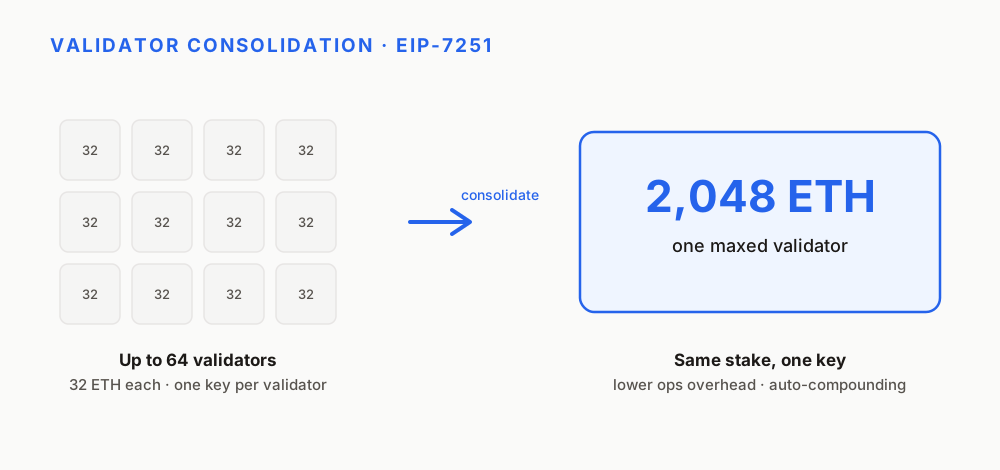
EIP-7251 in one picture — the flagship flow the tool was built around.
Building a consumer tool on top of a feature that doesn't exist yet is its own kind of discipline. You're testing against devnets and testnets that don't perfectly mirror what mainnet will do, writing flows for behaviour you can't fully observe until the fork actually lands. Which is how we found the interesting part.
What our testing uncovered
Working through the consolidation and withdrawal flows alongside Pier Two's validator engineers, we kept running into behaviour that wasn't cleanly spelled out anywhere in the docs at the time — the practical interaction between consolidation and the new withdrawal paths.
Here's the insight. Ethereum has an exit queue for validators fully leaving the network, and when demand spikes that queue can stretch to 40-plus days. But Pectra introduced a separate path: with a validator consolidated into a maxed balance, you can pull funds out via execution-layer partial withdrawals (EIP-7002) — any amount above the 32-ETH floor — through their own FIFO queue that clears in hours to days, never touching the multi-week exit queue at all. Consolidate into a maxed validator, then partially withdraw. For anyone needing to offboard funds quickly — switching providers, rebalancing treasury — that's a materially faster route out.
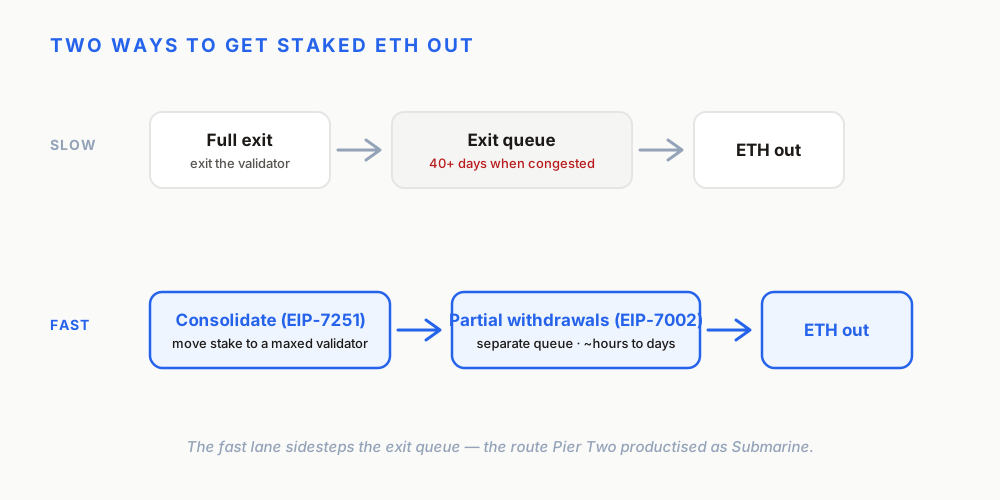
The route-around: consolidate, then withdraw partially — sidestepping the exit queue entirely.
That finding — that consolidation plus partial withdrawals could route around the exit queue — became the seed of a product. Pier Two went on to build and ship it as Submarine: their solution to accelerate staked ETH withdrawals via the consolidation path rather than the exit queue. It's a good example of something I've come to believe strongly: the genuinely useful features often don't come from reading the spec, they come from building against it and noticing what the spec didn't say.
The night it went live
Which brings me back to the livestream. Protocol upgrades are anticlimactic by design — the whole point is that nothing breaks — but there's still a moment when the fork activates and the first blocks come through under the new rules, and everything you built on the assumption that this will exist suddenly does. Watching the first consolidations flow through Pectra Staking Manager, live, with the team that operates the validators underneath, was one of the more satisfying go-lives I've been part of. No drama. Just a feature that had been a slide for a year quietly becoming real, transaction by transaction.
I like being close to that seam — where a protocol change becomes a thing a person can actually click. If you're working on staking, validator tooling, or anything in this corner of Ethereum, I'm always up for comparing notes.
Sources
- Pier Two — Pectra withdrawals explained
- Pier Two — introducing Submarine
- ethereum.org — MaxEB (EIP-7251)
- Ethereum Improvement Proposals — EIP-7251 · EIP-7002
- Consensys — Understanding Ethereum's Pectra upgrade
- Pectra Staking Manager — the tool referenced throughout
Backdated to Pectra's launch week in May 2025 and written up for the record. Pier Two's Submarine product, built on this work, shipped later; I've kept the piece in the present tense of the time. I work on the delivery side of frontier tech — these are my own views.
Written by Luke Shulver — Senior Project Manager at Galaxy.
Get in touch→